Located in Novi, MI
A Low Vision Evaluation Built Around Your Goals
Most eye exams ask what you can read on a chart. A low vision evaluation asks what you want to do again: read the mail, sort pills, see a grandchild's face, drive to the store. At Beyond Low Vision in Novi, Dr. John P. Jacobi builds your plan from that answer.
What the Evaluation Actually Measures
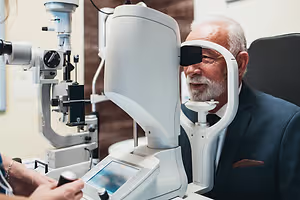
A standard eye exam checks eyesight and eye health. A low vision evaluation checks function: how your eyes perform on the tasks your day is made of. That means measuring sight at the distances you actually use, not only at 20 feet.
We look at how much detail you can pick out, how well you handle low contrast such as grey text on white or a curb in flat light, how your side vision behaves, whether your eyes still work together, and how glare and lighting change everything. Those answers decide which tools have a real chance of helping.
If you want the clinical background first, start with the conditions that lead to vision loss.

What the Evaluation Covers
Acuity at Working Distances
Reading distance, screen distance, and street distance each get measured. A power that works for a book rarely works for a sign across a parking lot.
Contrast Sensitivity
Many patients read letters in a bright room and lose the same words on a pale form. Contrast testing finds that gap, and it often explains more than sharpness does.
Visual Field and Side Vision
Where vision has dropped away matters as much as how sharp the center is. Field testing shows what is left and where to aim it.
Glare, Lighting, and Eye Teaming
Glare, uneven light, and eyes that no longer work as a pair all change what is readable. We test for each, because each has its own answer.
How This Differs From a Routine Eye Exam
Both matter, and they do different jobs. Your optometrist or ophthalmologist watches for disease, checks eye health, and manages treatment. A low vision evaluation takes the vision that is left and works out how to use it.
Many patients arrive having been told that nothing more can be done. That is often true of the medical side and rarely true of daily function. This visit is about the second question.
If you are due for a regular eye exam, or you want a report from your retina specialist reviewed, bring it along. We work alongside your other care rather than replacing it.
Trying the Aids Is Part of the Visit
You do not leave with a recommendation and hope. Magnifiers, telescopes, filters, and electronic devices come out during the appointment, and you try them on your own material: your mail, a book, your phone, a menu, a pill bottle.
One aid often suits a task and fails at another. The trial is how we find out which is which before you spend anything on the wrong one.
To know the shape of the appointment before you book, read what to expect at your visit.

What to Bring to Your Appointment
- Your current glasses, including any reading pair
- A list of your medications and your eye history
- Reports from your retina specialist, ophthalmologist, or neurologist, if you have them
- Two or three things you actually struggle with, such as a bill, a book, a phone screen, or a medication label
- A family member or caregiver, if you would like someone with you
What You Leave With
You leave knowing three things: what your vision is doing, which tools helped you on the day, and what happens next. Usually that means a device or two to try at home, a plan for anything that needs practice, and a follow-up visit once you have lived with it for a while.
Nothing is prescribed on a guess. If a tool did not help in the room, it does not go home with you.
This is a cash-pay service, and the payment policy explains how that works before you arrive. You can also browse the low vision aids we work with, or the wider low vision services at the practice.
Common Questions About the Evaluation
No. A regular eye exam checks your eyesight and eye health and looks for disease. A low vision evaluation starts from the tasks you want to get back and measures how your vision performs on them, then matches tools to what it finds. Many patients have both, and the two work together.
No. Devices are tried during the visit and nothing is ordered unless it clearly helped you with a real task. Some patients leave with a plan and a trial period rather than a purchase.
Yes, and it often helps. A spouse, adult child, or caregiver can hold the information, ask the questions you forget, and hear the training the first time round.
That is the most common reason patients find us. Medical treatment and daily function are separate questions. Even when a condition cannot be reversed, there is often a great deal that can be done with the vision you still have.
The practice is a cash-pay clinic, so the payment policy page is the place to check how fees and payment work before you book. Call us if anything there is unclear.
Start With a Free Phone Consultation
A free phone consultation is the simplest first step. You talk through what has changed, what you want back, and whether an evaluation makes sense. No form to fill in first, no obligation.
Dr. Jacobi has spent more than 36 years in low vision and binocular vision care, and he is a Fellow of the International Academy of Low Vision Specialists. You can read more about Dr. Jacobi before you call.