Located in Novi, MI
Bioptic Telescope Glasses for Distance Vision
You slow down at an intersection you have driven a thousand times, because the street sign overhead stays out of reach. Or you skip the church bulletin, the grandchild's face across the room, the aisle marker in a store you have shopped for years.
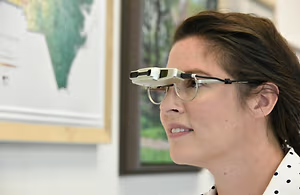
A bioptic telescope is a small telescope mounted on a pair of glasses. It will not give you back your old vision, and it will not do the work for you. What it can do is let you spot the distance detail a stronger prescription alone cannot recover. At Beyond Low Vision in Novi, Dr. John P. Jacobi fits and trains patients with bioptic systems, including patients who want to explore driving again.
What a Bioptic System Actually Is
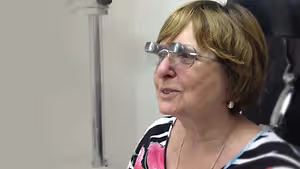
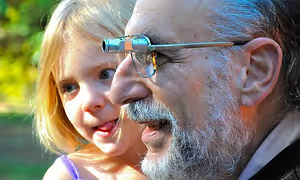
A bioptic system is a pair of glasses with a small telescope built into the upper part of one lens, and sometimes into both. You look through the ordinary carrier lens for nearly everything: walking, watching the road, talking with someone across a table. When you need distance detail, you tilt your head slightly and look through the telescope for a second or two.
That is the whole idea. The telescope magnifies a small window of the world, so you use it in short looks rather than long stares.
Most systems are built for one patient. The power of the telescope, the eye it sits above, and the frame are all chosen around your vision and the tasks you care about.
Distance Detail Bioptics Can Bring Back
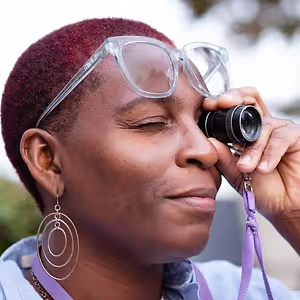
Bioptic telescopes work on detail that sits well beyond arm's length, the kind a stronger prescription stops short of recovering. Patients tell us they use theirs for:
- Street signs, exit markers, and route numbers
- Bus numbers and airport gate displays
- Traffic lights and the vehicles ahead
- Faces across a room, a church, or a waiting room
- A television screen, a stage, or a scoreboard
- A whiteboard or presentation slide in class or at work
- Aisle signs in a store and menus on a wall
If one of these is your main goal, say so at your evaluation. The power and mounting that suit a driver differ from what suits a student in a lecture hall.
How Bioptics Differ From a Magnifier
A hand-held magnifier or a pair of strong reading glasses is built for close work: mail, a menu, a pill bottle, a book. A bioptic telescope is a spotting device for distance. You would not read a novel through it, and you would not want to. The field of view inside a telescope is small, so it shows you a sign or a face, not a room.
The comparison changes how you use the device. A magnifier stays on the page until you are finished. A bioptic telescope comes up for a second, answers a question, and comes down again while the carrier lens takes over.
If your goals lean toward reading and close work, our reading telescopes and magnifiers page covers those tools. Many patients end up with more than one device, each matched to a different task.
Your Evaluation and Fitting Visit
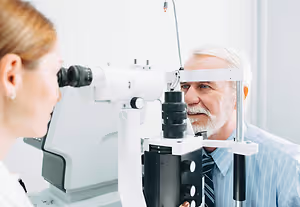
An evaluation comes before any decision about a device. Dr. Jacobi starts by asking what you want to see again, because a driver's answer sounds different from a teacher's, a woodworker's, or a grandparent's.
From there, the visit covers:
- A review of your eye health, your current prescription, and how your eyes behave at distance
- Measurements of how much magnification you can use and still see comfortably
- Time to try different telescopes, powers, and mounting positions in the office
- A frame check, since a telescope that shifts on your face between looks will not work
- A conversation about which task to practice first at home
Fitting continues across more than one visit. The frame gets adjusted, the telescope position is refined, and you come back so we can see what has changed for you at home. If you are unsure what a low vision appointment involves, our low vision evaluations page walks through the visit.
Training Is What Makes Bioptics Usable
A bioptic telescope is easy to look through. Using it while the world keeps moving is the part that takes practice. The skill is the switch: carrier lens, telescope, carrier lens again, in a rhythm that matches what you are doing.
Dr. Jacobi teaches that switch in the office before you take the device home, and again at follow-up visits. You practice finding a target, holding on it long enough to read it, and returning your eyes to the wider view.
Head position matters too. Most systems ask for a slight downward tilt of the head rather than a lifted chin, and that tilt has to feel natural before it becomes reliable.
Patients who practice a few minutes each day get comfortable faster than patients who wait for the right occasion to use the device.
Driving With Bioptics in Michigan
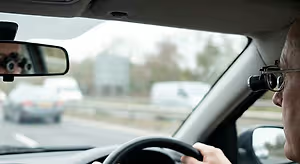
Many patients come to us hoping to drive again. Bioptic driving is allowed in Michigan for drivers who meet the state's requirements, and every state sets its own rules.
Michigan's process includes vision standards and licensing steps administered by the Michigan Secretary of State. Confirm the current requirements with the Michigan Secretary of State before you plan around driving, because forms, testing steps, and conditions change, and the licensing decision belongs to the state.
We handle the vision side: the evaluation, the prescription, the fitting, and the training that helps you use the device the way a driving evaluation will expect. We cannot promise that you will pass a driving test or be approved to drive.
If driving is one of your goals, mention it at your first visit so the evaluation and the training plan are built around it.

What to Expect in the First Weeks
The first week is usually uneven. Spotting a sign comes quickly, while a moving target such as a bus number takes longer. Both are normal.
A pattern that works for many patients:
- Days one to seven: short practice at home, spotting objects in a familiar room and then through a window
- Week two: one real errand with the device, with a family member or friend along if that feels steadier
- Weeks three and four: longer outings in different lighting, plus a follow-up visit to adjust what still feels awkward
Concentration is tiring at first. Short sessions work better than long ones, and a break restores your ability to stay with the switch.
The Honest Limits of Bioptics
Bioptic telescopes magnify a small field, and that is the trade-off at the center of the device. What you see inside the telescope is bigger, but you see less of the world at once, which is why patients look through it briefly instead of steadily.
It does not cure vision loss and does not replace the vision you already use. It sits alongside your carrier lens, your lighting, your other aids, and your own practice.
Bioptic telescopes do not suit every eye condition. Vision that is very reduced, a visual field that is very narrow, an eye that cannot hold steady focus, or hands that struggle with a frame can all change what will help you. Some patients do better with full-diameter telescopes, electronic magnifiers, or contrast aids, and others combine two or three tools.
You will know where you stand after an evaluation, not before one.
Common Questions About Bioptics
Many patients do, using the carrier lens for everyday vision. The telescope stays out of the way until you need distance detail, and then you look through it for a moment or two before returning to the wider view.
Michigan allows bioptic driving for drivers who meet its requirements, which the Michigan Secretary of State sets and reviews. We prepare the vision side and the training. The licensing decision is the state's, so confirm the current rules with the Secretary of State before you count on driving.
It depends on your plan and on how the device is documented. Bring your vision and medical cards to your visit and we will explain what information your plan may ask for. Call us if you would like to check before you come in.
Most patients feel steadier with the switch after a few weeks of short daily practice. Comfort varies from person to person, and follow-up visits are where we fine-tune the fit and the telescope position.
Yes. It usually sits above the eye with the better distance vision, and some patients have a telescope on each lens. The evaluation shows which arrangement gives you the steadiest view.
A bioptic telescope is small and mounted on your glasses, so you can wear it while you move around. A full-diameter telescope is larger and built for stationary distance tasks such as watching television.
Other Low Vision Aids to Consider
Bioptic telescopes answer one kind of question. If contrast, glare, reading, or screen work is the harder problem, another tool may help more, and many patients use more than one.
- Low vision aids overview, for the full range of devices we fit
- Reading telescopes and magnifiers for close work, mail, and books
- E-Scoop contrast-enhancing glasses for clarity in low light and glare
- Electronic and digital aids for zoom and contrast on a screen
During your evaluation you can try several of these in one sitting and see which combination fits your routine.
Talk Through Bioptics With Dr. Jacobi
Dr. John P. Jacobi is the low vision optometrist at Beyond Low Vision in Novi. He is a Fellow of the International Academy of Low Vision Specialists (IALVS) with more than 36 years of clinical experience, and he fits and trains patients with bioptic systems himself. Meet Dr. Jacobi.
A free phone consultation is a conversation about your goals: driving, faces across a room, television, school, work. Call or text (248) 731-9393 and we will find a time to talk. If you are not sure whether a bioptic system is the right place to start, that is a fair question to bring to the call.