Located in Novi, MI
Reading Telescopes & Magnifiers
Reading is the first thing most people ask us to bring back. It is also what reading telescopes and magnifiers are designed for. At Beyond Low Vision in Novi, Dr. John P. Jacobi matches the aid to the way you actually read.

Why Stronger Glasses Stop Working
Nearly everyone who comes to us about low vision starts with the same sensible request: a stronger pair of glasses. For a while it helps. Then it stops.
A stronger prescription does magnify, but it cannot replace detail the retina is no longer picking up. At some point each increase in power adds very little clarity and costs something real: the page has to sit closer, less of it fits in view, and the light has to be better.
That is where the reading toolbox begins. Instead of pushing one number higher, we change the tool. Reading telescopes and magnifiers put a larger image in front of the eye at a workable distance, and they can be chosen for the task in front of you rather than for a single prescription.

Four Tools in the Reading Toolbox
Four families of aids cover most reading problems. They are not ranked against each other. Each does a different job, and plenty of patients leave with more than one.
Telescopic and Prismatic Reading Glasses
These are worn like glasses and used for sustained close work: a book, a magazine, a letter, a hobby that needs both hands free. Telescopic spectacles place a small telescope in front of each eye. Prismatic reading glasses use prisms so you can read at a more comfortable distance while keeping a wider view than a telescope alone allows. They suit longer sessions where you want your hands on the page, not on a device.
Hand-Held Magnifiers for Quick Looks
A hand-held magnifier is the tool for a few seconds of reading: the mail, a label, a menu, a bank statement, a prescription bottle. You hold it over the print, move it until the letters come into focus, and set it down again. It is portable and forgiving, and it is often the first aid we put in a patient's hand in the exam room.
Stand Magnifiers for a Printed Page
A stand magnifier rests on the page, which fixes the distance between lens and print for you. That fixed distance is the point. If your hands shake or tire, or if holding focus at a set distance is hard, a stand magnifier keeps the image steady while you move the page instead. Many models have a built-in light, and that light matters as much as the power.
Hands-Free Options for Hobbies
Cooking, knitting, sewing, model building, crossword puzzles, cards at a table: these need both hands and a steady view. Hands-free designs include head-borne magnifiers, floor and table stands, and wearable prismatic or telescopic systems. They cost more than a hand-held lens and take a little practice, but they let you look up and down at will without reaching for anything.

Magnification, Distance, Field, and Light
Four things move together in every reading aid. Change one and the others shift, so most of the fitting conversation is about which combination you can live with.
- Magnification: how much larger the print becomes. More power gives larger letters, but only up to the limit your eye can use.
- Working distance: how far the page sits from your eye. Higher power shortens it, which is why a very strong aid can leave the page almost at your nose.
- Field of view: how much of the page you see at once. More magnification means less text per look, so you move the page or your eye more often.
- Lighting: higher power needs more light to hold contrast. A good reading lamp or a built-in light often does as much as the optics.
You are not shopping for the strongest aid. You are choosing the balance that lets you read for the length of time you actually want to read.
How We Measure the Right Power
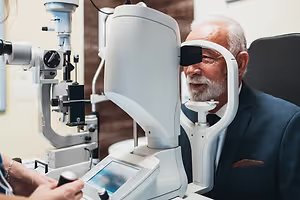
An aid chosen by guesswork is the most common reason one ends up in a drawer. We do not guess. During your low vision evaluation, Dr. Jacobi measures the print size you need, the distance you can hold comfortably, and how long you can sustain it before your eyes tire. Those measurements point to a starting power, and then we test it with you.
Your eye condition shapes the answer as much as the numbers do. Central vision loss, a narrowed field, a cataract, or a field cut after a stroke each change which aid will serve you. Dr. Jacobi has practiced low vision care for more than 36 years and is a Fellow of the International Academy of Low Vision Specialists (IALVS). You can read more about his approach.
Try Several Options in One Visit
A magnifier looks simple in a catalog and feels entirely different in your hand. So we put several in front of you in the same visit: different powers, hand-held and stand styles, a telescope, a hands-free option, and an electronic magnifier when that is the better route. You compare them back to back, on your own reading, while there is still time to change your mind.
Nothing is ordered from a description. If an aid does not feel right in the room, it will not feel right at home, and we would rather find that out with you than after.
Practice With Your Own Book and Phone
Fitting day is practice, not a handover. We work through whatever you brought: a page of a novel, an envelope, a bill, a text message, a phone screen. You learn where to hold the aid, how far to sit from the page, how to find the next line, and how to move the lens without losing your place.
Reading with an aid is a physical skill, and it gets easier over a few days of use. You will leave knowing what to practice. If something does not feel right once you are in your own chair and your own light, call us and we will work it out with you.
The Honest Limits of Higher Power
No aid restores the vision you had at 40, and the strongest aid is rarely the most useful one. These trade-offs are real:
- The higher the power, the smaller the field. You see fewer words per look and you scan more.
- The higher the power, the shorter the working distance. Some telescope and microscope designs are used with the page very close.
- The higher the power, the more light you need to keep print crisp.
- The longer you read, the more fatigue matters. A moderate aid you can use for 30 minutes often beats a powerful one you can only tolerate for five.
We will tell you plainly when a device will not do what you are hoping for, and when another category is the better answer, such as a digital magnifier or a contrast aid.
Common Questions About Reading Aids
No. A stronger prescription magnifies, but it is still limited by the detail your retina can resolve, and each increase costs field and working distance. A reading telescope, prismatic reading glasses or a magnifier places a larger image in front of the eye in a way a prescription alone cannot. That is why we fit and measure rather than simply adding power.
It depends on the job. Hand-held magnifiers suit quick looks at a label, mail or menu. Stand magnifiers suit a printed page and a longer sitting, and they keep the distance steady if your hands shake or tire. Many patients end up with both, and we can show you the difference in one visit.
Sometimes, but not usually. Most patients settle on two: a pocket magnifier for short tasks away from home, and something steadier at a table, like a stand magnifier, prismatic reading glasses or a hands-free system. We fit for the tasks you actually do, not for an average of them.
Most people notice the improvement immediately and feel more settled after a few days of regular use. Reading with an aid is a physical skill: finding your place, holding the working distance, and moving the lens or the page smoothly all improve with practice. We send you home knowing what to practice.
Bring the things you read most: a book, mail, a bill, a recipe, your phone or tablet. Bring your current glasses, including any reading glasses you use now, and any aids you have already tried. Real material tells us far more than a printed chart.
They can help with many kinds of vision loss, including macular degeneration, diabetic retinopathy, glaucoma, and vision changes after a stroke, but the useful aid and the right power differ from one eye condition to the next. That is why the evaluation comes first and the recommendation second.
More Low Vision Aids to Explore
Reading is one part of the picture. Our main low vision aids page shows the full range we fit. From there you can read about bioptic telescopes for driving and spotting detail at a distance, eScoop contrast-enhancing glasses for glare and contrast, and electronic and digital aids such as video magnifiers.
If you have not had a low vision evaluation yet, that is the right first step. Call or text (248) 731-9393 to request a free phone consultation with Dr. Jacobi.

Request a Free Phone Consultation
Tell us what you would most like to read again: the newspaper, a recipe, a message from your granddaughter, the novel on your nightstand. That answer is where we start, and it is usually where the right aid becomes clear.
Beyond Low Vision is in Novi, Michigan. Call or text (248) 731-9393, or request a free phone consultation with Dr. Jacobi and we will talk through your options.